

The Overlooked "Narrow‑Spectrum Specialist": How Fusidic Acid Precisely Protects Skin and Bone Health
The Overlooked "Narrow‑Spectrum Specialist":
How Fusidic Acid Precisely Protects Skin and Bone Health
Within the vast family of antibiotics, Fusidic Acid occupies a unique position. It is neither a broad‑spectrum "killer" like the penicillins, nor an all‑round warrior of the cephalosporin family. Instead, it is a precise "narrow‑spectrum specialist" – a sniper focused on Gram‑positive bacteria, particularly Staphylococcus aureus (including MRSA).
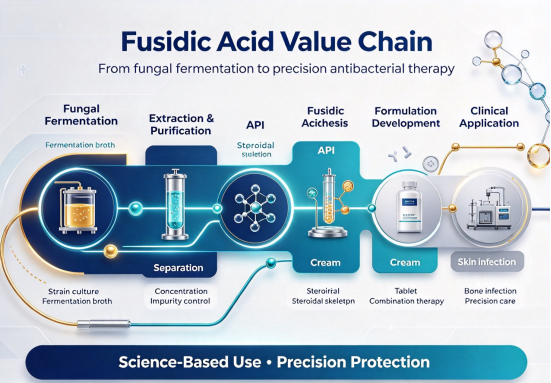
Since its first isolation from the fungus Fusidium coccineum in 1962, Fusidic Acid has been used clinically in Europe for over 60 years. Yet it never received US FDA approval, only re‑entering clinical development in recent years due to the rise of MRSA. This journey – "blooming abroad while unknown at home" – precisely reflects its unique and irreplaceable value.
Molecular Identity: An Antibiotic "Disguised" as a Hormone
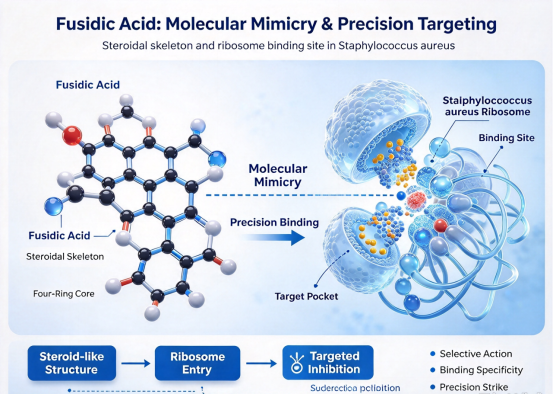
The chemical structure of Fusidic Acid is remarkably deceptive – it possesses a steroid four‑ring backbone, yet exhibits no hormonal activity whatsoever. This unique "fusidane" skeleton gives it two key advantages: excellent skin penetration, and the rare property of no cross‑resistance or cross‑allergy with other antibiotics.
Mechanistically, Fusidic Acid binds to bacterial elongation factor G (EF‑G), preventing ribosomal translocation during translation, thereby precisely blocking bacterial protein synthesis. A 2024 cryo‑electron microscopy study published in Scientific Reports resolved the structure of the Fusidic Acid‑S. aureus ribosome complex at 2.5 Å resolution, revealing for the first time at the atomic level the details of its inhibition of a clinical pathogen.
Antibacterial Spectrum: Narrow, But Precise Enough
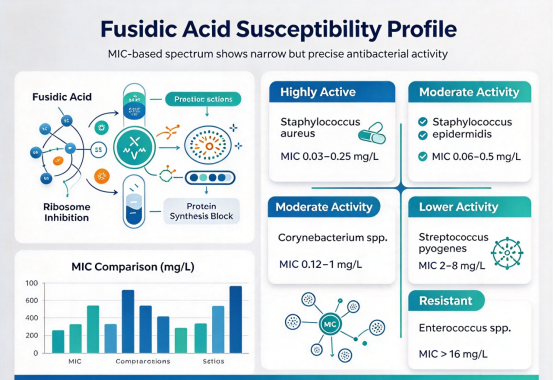
Fusidic Acid's spectrum focuses on Gram‑positive bacteria. Research data show that its MIC against Staphylococcus aureus can be as low as 0.25 µg/mL, with potent activity against Corynebacterium spp. and Micrococcus luteus as well. In contrast, enterococci and streptococci show lower susceptibility (MIC ranges of 2–8 µg/mL and 16–32 µg/mL, respectively), while Gram‑negative bacteria are generally insensitive.
In today's world of escalating antibiotic misuse, this "narrow‑spectrum" characteristic has become an advantage – it precisely targets the pathogenic bacteria while causing less disturbance to normal flora.
Notably, the combination of Fusidic Acid with rifampicin significantly enhances antibacterial activity, an important clinical strategy against resistance risk. In recent years, scientists have also developed a novel derivative, FA‑cyclopentane, whose cyclopentane group forms additional contacts with EF‑G and 23S rRNA, demonstrating stronger resistance to resistance mutations.
Dermatology: From Impetigo to Eczema Infection
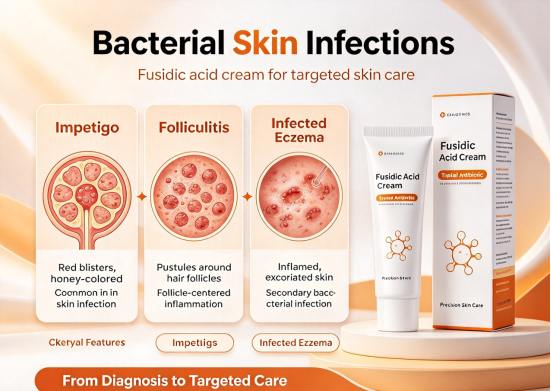
Fusidic Acid has its widest application in dermatology. Its indications cover impetigo, folliculitis, furuncles, carbuncles, paronychia, erythrasma, and wound infections, among other skin and soft tissue infections. For acne vulgaris, it helps improve inflammatory lesions by inhibiting the proliferation of Cutibacterium acnes.
Even more noteworthy is its adjunctive value in atopic dermatitis/eczema. When eczema is secondarily infected by S. aureus, or when staphylococcal superantigens may aggravate the condition, topical combination formulations of Fusidic Acid with betamethasone or hydrocortisone have proven highly effective. This dual "antibacterial + anti‑inflammatory" strategy offers new solutions for stubborn eczema.
A 1977 clinical study compared 2% sodium fusidate ointment alone with oral antibiotics (clindamycin, erythromycin, or flucloxacillin). Results showed that the fusidic acid ointment group had significantly shorter healing times, with subjective clinical response ratings also highly superior to the oral antibiotic group.
Orthopaedics & Systemic Infections: From Bone Penetration to Combination Therapy
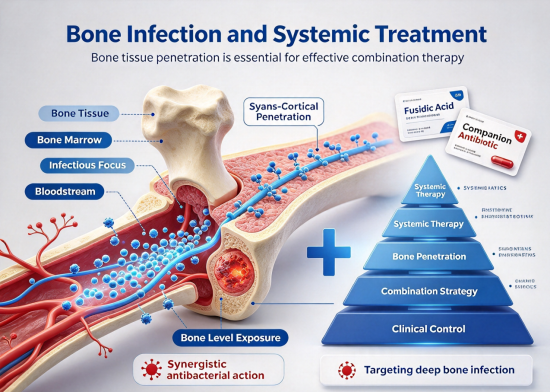
Another unique advantage of Fusidic Acid is its excellent bone tissue penetration, making it an important option in the treatment of staphylococcal osteomyelitis, typically used in combination with β‑lactam antibiotics to prevent the selection of resistant mutants.
In systemic infections, Fusidic Acid can be used for conditions such as septicaemia and pneumonia. A Phase II randomised controlled trial showed that oral Fusidic Acid (1500 mg every 12 hours loading dose on day one, followed by 600 mg every 12 hours maintenance) was comparable in efficacy to linezolid. This "loading + maintenance" dosing regimen is precisely an optimised strategy designed to reduce resistance risk.
However, the issue of Fusidic Acid resistance cannot be ignored. Protective genes such as fusB, fusC, and fusD spread via plasmids, selected primarily through topical monotherapy. A 2025 metabolomics study further revealed the metabolic reprogramming mechanisms of resistant strains, providing new biomarkers for resistance monitoring.
Market Landscape: Chinese API Dominates Globally
From a market perspective, Fusidic Acid displays distinctive industrial characteristics. The global fusidic acid formulation market is valued at approximately USD 1.6 billion, while the Chinese market exceeds RMB 1.8 billion, maintaining a compound annual growth rate of around 6% over the past three years.
Most noteworthy is the API landscape: over 70% of the world's sodium fusidate API is supplied by Chinese manufacturers. The core compound patent of the originator, Leo Pharma of Denmark, expired in the 1990s, and more than 30 domestic companies have now been approved to produce related formulations, covering injections, creams, eye drops, and other dosage forms. With the advancement of centralized procurement policies, API supply stability and quality compliance have become core criteria for downstream formulation companies in selecting suppliers.

Safety and Rational Use
Fusidic Acid has a generally favourable safety profile, though adverse reactions vary by dosage form. Oral formulations mainly cause gastrointestinal reactions (dyspepsia, nausea, vomiting); high‑dose intravenous administration may cause reversible jaundice; topical skin use mainly presents as local irritation, rash, and itching. Long‑term, large‑area topical use should be avoided to prevent excessive absorption and systemic reactions.