

Acai berry antioxidant: Polyphenol system, brain and liver protection
Acai Berry: From Amazon Rainforest to Global Functional‑Food Market
As a well‑known "superfruit", acai berry has expanded from the Amazon rainforest to global markets, and its signature deep‑purple colour is one key contributing factor. This distinctive appearance not only delivers high visual recognizability but also signals an important class of plant‑active compounds: anthocyanins. Thanks to its abundant anthocyanin content, public attention toward acai berry has long centred on one keyword — antioxidant activity.
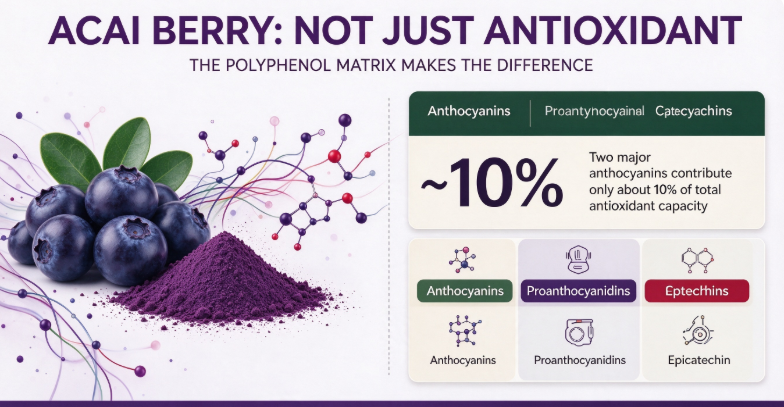
Nevertheless, one easily overlooked detail is that acai berry's antioxidant capacity cannot be attributed solely to anthocyanins. A landmark study revealed that although the two major anthocyanins in acai pulp are vital constituents, they contribute an estimated merely 10 % to total antioxidant performance. This indicates that acai berry's real antioxidant effect most likely arises from the combined action of diverse polyphenols, flavonoids and other phytochemicals, rather than from a single "super‑ingredient" working in isolation. In other words, what truly merits attention for acai berry is not merely the word "antioxidant", but its complete polyphenol profile.
Insight from Food Innovation Institute: This finding delivers straightforward implications for product development. Formulation strategies focused exclusively on anthocyanin content may be misdirected. The true value of acai berry lies in its "polyphenol matrix": the synergistic effects among anthocyanins, proanthocyanidins, catechins, epicatechin and other phenolic substances form the mechanistic basis for its bioactivity in neuro‑inflammation modulation and metabolic regulation. Accordingly, for raw‑material procurement and quality control, testing only anthocyanin levels is insufficient to evaluate material quality; a comprehensive polyphenol‑spectrum assessment system should be established.
This also opens new avenues for further research. Instead of merely measuring bulk antioxidant capacity, scientists have begun investigating which cellular processes these polyphenols actually modulate, shifting the overall research paradigm for acai berry.
1 Research on Brain Neuroinflammation Neuro Study
A 2021 study published in Molecular Neurobiology specifically targeted the NLRP3 inflammasome. Under physiological conditions, microglia survey the micro‑environment, clear damaged cells and maintain neural‑tissue homeostasis. However, sustained oxidative stress, metabolic disturbance or other stimuli may trigger excessive microglial activation, releasing multiple pro‑inflammatory mediators. Chronic activation of this cascade gives rise to neuroinflammation.
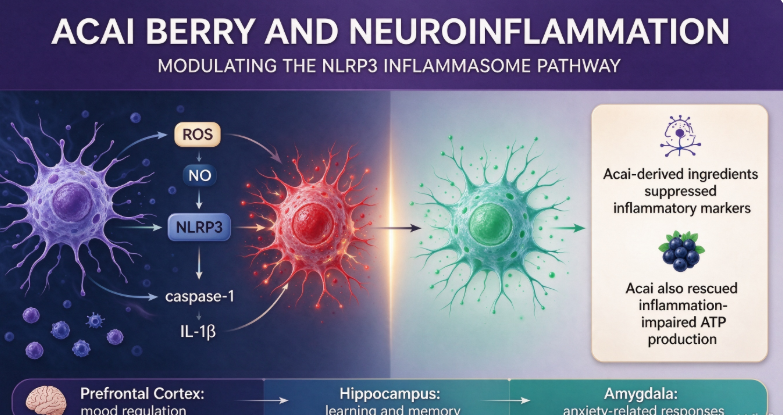
In cell‑based assays, researchers induced inflammatory responses in microglia using LPS plus nigericin. Elevated ROS, NO, as well as inflammatory markers including NLRP3, caspase‑1 and IL‑1β were observed. Treatment with acai‑derived preparations reversed these alterations to varying degrees and rescued inflammation‑impaired ATP production. This suggests that bioactive components from acai berry exert more than general antioxidant effects; they may intervene in the NLRP3 inflammasome signalling pathway within microglia.
✦ A 2026 study further advanced this line of investigation.
This research used adolescent rats rather than adult animals. Animals received nutritionally relevant doses of phenolic‑rich clarified acai juice. Multiple endpoints were assessed: oxidative‑stress status and antioxidant defence across distinct brain regions, plus behavioural tests for anxiety‑like and depression‑like phenotypes.
Acai juice intake correlated with modified antioxidant profiles in selected brain compartments. Increased expression of antioxidant enzymes was detected in the prefrontal cortex and ventral hippocampus, while oxidative status was lowered in the amygdala. The prefrontal cortex governs mood regulation, decision‑making and stress responses; the hippocampus participates in learning, memory and emotional modulation; the amygdala mediates fear‑ and anxiety‑related behaviours. Notably, the team compared region‑specific responses instead of only examining whole‑brain changes.
Behavioural assays demonstrated amelioration of anxiety‑like and depression‑like behaviours in acai‑treated rats. Collectively, the study documented two tiers of outcomes: biochemical shifts in cerebral oxidative‑stress / antioxidant markers and corresponding behavioural modifications in‑vivo.
2 New Research on Hepatic Protection Liver Study
Another 2026 investigation published in Molecules (August 2026) focused on liver mitochondria. Instead of the commonly‑studied acai pulp, the work analysed acai seeds, an under‑valued processing by‑product. Seeds account for 80 %‑95 % of total fruit weight and are routinely discarded during manufacturing. Still, they are rich in catechins, epicatechin, proanthocyanidins and other polyphenols, prompting exploration of their functional potential.
Insight from Food Innovation Institute: Global acai‑berry market reached approximately USD 3.7 billion in 2024 and is projected to hit USD 5.5 billion by 2030, representing a 6.8 % compound annual growth rate. Growth is mainly driven by functional beverages and better‑for‑you food segments. Application formats keep diversifying: besides juices, yoghurts and baked goods, freeze‑dried powder is the mainstream format for preserving core nutrients such as anthocyanins. Processing technology directly determines nutrient retention and cost structure. Freeze‑drying achieves superior nutrient retention yet carries high costs; spray‑drying costs less but nearly deactivates anthocyanins. Product developers must balance performance claims against manufacturing costs according to product positioning.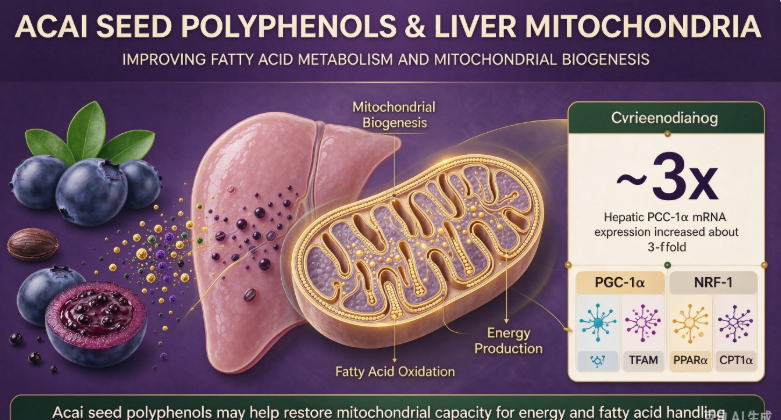
Researchers established a rat model of metabolic dysfunction‑associated steatotic liver disease (MASLD) via high‑fat feeding. Animals received polyphenol‑rich acai‑seed preparations, aerobic exercise, or combined acai‑seed polyphenols plus exercise intervention. Compared with the high‑fat control group, acai‑seed polyphenol treatment markedly alleviated hepatic steatosis; histological analysis reported around a 52 % reduction in steatosis severity. More importantly, effects extended beyond simple fat accumulation and targeted mitochondria, the central organelle governing hepatocyte energy metabolism.
The liver is a primary metabolic organ responsible for processing fatty acids and energy substrates. High‑fat diets flood hepatocytes with fatty acids and impose heavy metabolic burden on mitochondria. Deteriorated mitochondrial energy production and fatty‑acid oxidation promote lipid deposition alongside amplified oxidative stress, forming a vicious pathological cycle. Consequently, modern MASLD research has moved past quantifying liver fat content toward evaluating whether hepatocytes retain functional capacity for lipid disposal.
Acai‑seed polyphenol supplementation significantly up‑regulated markers related to mitochondrial biogenesis including PGC‑1α, NRF‑1 and TFAM in liver tissue. PGC‑1α acts as a master regulator of mitochondrial biogenesis and energy metabolism; NRF‑1 modulates transcription of mitochondrial‑related genes; TFAM maintains and replicates mitochondrial DNA. In this trial, hepatic PGC‑1α mRNA expression was elevated by roughly 3‑fold. These observations indicate that acai‑seed polyphenols do not merely scavenge free radicals; they actively modulate the mitochondrial biogenesis programme in hepatocytes.
Direct mitochondrial functional measurements further supported this conclusion. High‑fat feeding triggered abnormal mitochondrial morphology and lipid‑driven decline in mitochondrial respiratory capacity; acai‑seed polyphenol treatment reversed these defects. Concurrent changes in fatty‑acid‑metabolism‑related molecules such as PPARα and CPT1α suggested improved hepatic fatty‑acid utilisation. To summarise: when challenged with excess fat load, polyphenols extracted from acai seeds not only mitigate oxidative pressure but also partially restore mitochondrial competence for energy and fatty‑acid handling in liver cells.
Visit our official website https://www.ruizelinbio.com/ to check product specifications, download COA or send your inquiry.