

Lacticaseibacillus Paracasei The Gut Health Secret Backed by Science
Lacticaseibacillus paracasei
In the probiotic family, Lacticaseibacillus paracasei (formerly Lactobacillus paracasei) has become one of the most actively researched species in recent years. It is widely distributed in the human oral cavity and intestinal tract as well as in fermented dairy products. Thanks to strain-specific physiological functions, it is moving beyond traditional dairy fermentation into broader health and food applications.
What Is Lacticaseibacillus paracasei?
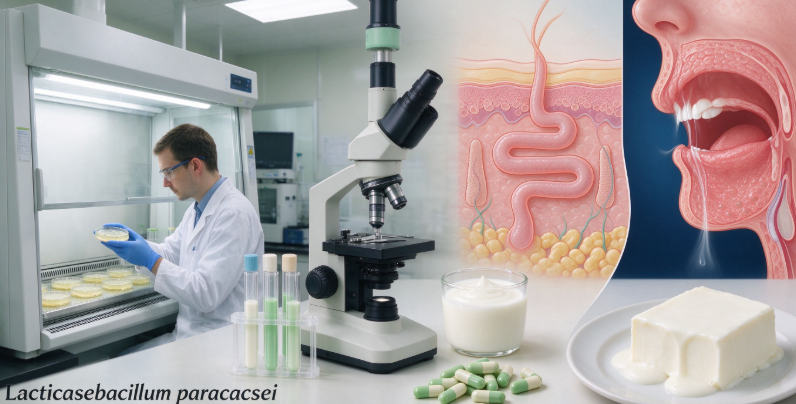
Lacticaseibacillus paracasei belongs to the Lactobacillus casei group within the genus Lactobacillus. It is a Gram-positive, non-spore-forming, facultatively anaerobic rod. It is not a single-function species—different strains differ at the genomic level, and their probiotic properties vary accordingly, which is a classic illustration of “strain specificity” in the probiotic field. Taxonomically, it was once classified as a subspecies of Lactobacillus casei; following taxonomic revision it became an independent species, and in both academic literature and industrial applications it is now referred to as Lacticaseibacillus paracasei (or Lactobacillus paracasei in older literature).
Core Health Effects: What Does the Evidence Point To?
Current research indicates that the health effects of L. paracasei are concentrated in the following areas:
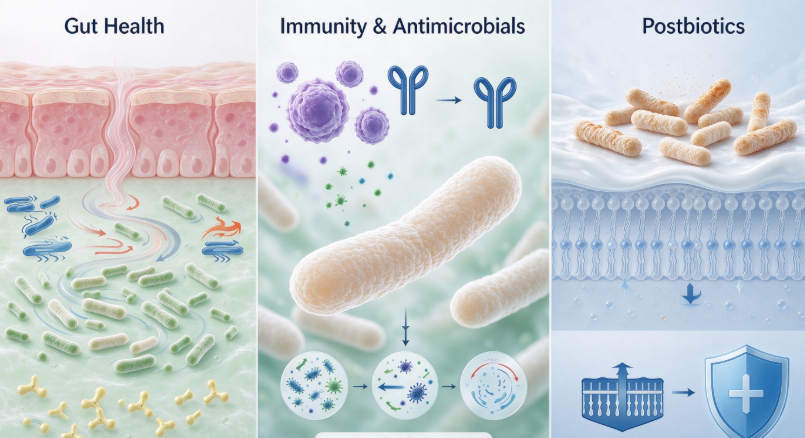
Gut microbiota modulation and constipation relief. Numerous animal studies and clinical observations show that specific L. paracasei strains can improve gut microbiota composition and promote gastrointestinal motility. For example, strain Glory LP16 showed potential to relieve symptoms in a mouse model of constipation; strain LPC-F was demonstrated to improve constipation-related indicators by promoting the proliferation of interstitial cells of Cajal. The mechanisms involve short-chain fatty acid production, secretion of gastrointestinal regulatory peptides, and maintenance of intestinal barrier function.
Immunomodulation and antimicrobial activity. L. paracasei can influence host immunity through multiple pathways, including modulation of the interaction between gut microbiota and the immune system and promotion of antigen-specific IgA production. Meanwhile, some strains produce antimicrobial substances that antagonize the growth of Gram-positive bacteria, Gram-negative bacteria, and various pathogens. In addition, review studies support its roles in balancing gut microbiota, antioxidation, and lipid metabolism regulation.
Exploration of the postbiotic direction. Notably, heat-treated L. paracasei (the “postbiotic” form) is also entering the clinical research spotlight. For instance, an inactivated preparation of strain LpD3.5 is being studied in patients with inflammatory bowel disease, aiming to observe its effects on the intestinal mucus layer and intestinal permeability while avoiding the infection risk associated with live bacteria. This offers a possible supplementation approach for immunocompromised populations.
Application Scenarios: Beyond Yogurt
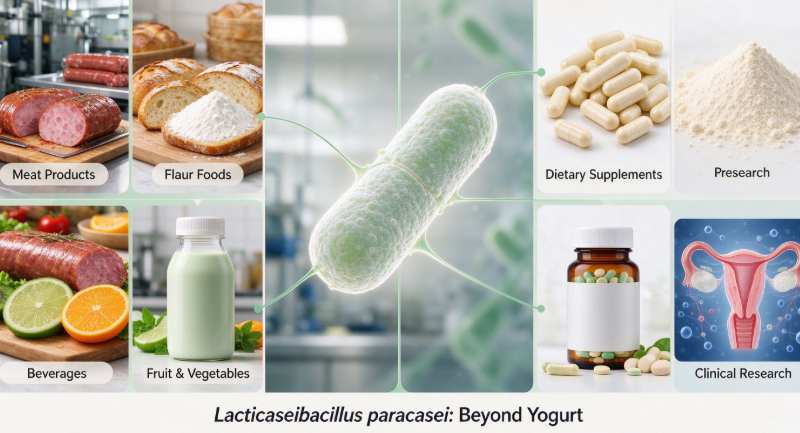
The applications of L. paracasei have long extended beyond traditional fermented milk. In the food industry, it is gradually expanding into meat products, flour-based products, beverages, and fruit and vegetable processing. Its fermentation characteristics—acid production capacity, flavor improvement ability, and texture contribution—make it a candidate strain for enhancing product competitiveness. One study screened advantageous strains suitable for fermented milk production from 60 L. paracasei strains, focusing on lactose metabolism efficiency and the synthesis of functional metabolites, reflecting a deepening industrial awareness that “strain performance determines product differentiation.”
In the fields of health foods and pharmaceutical intermediates, L. paracasei has likewise attracted attention. Patent literature documents specific strains with cyanotoxin clearance ability, immunomodulatory function, or bile salt tolerance, designed for use in food supplements or functional food bases. In addition, probiotic intervention studies for bacterial vaginosis also involve the L. paracasei strain VCare-360, with preliminary findings showing potential in antimicrobial activity and inflammation improvement.
⚠️ Strain matters. It should be noted that most of the above efficacy studies were conducted on specific strains and cannot be simply extrapolated to all products labeled “L. paracasei.” Strain designation, viable cell counts, and formulation processes all materially affect the final outcome.
Related company information: Xi'an Ruizelin Biotechnology Co., Ltd. is located in the Xi'an Economic and Technological Development Zone, Shaanxi Province. Its business scope covers the research, development, and sale of animal and plant extracts and chemical intermediates, as well as the technical development and sale of health care products and food. For more information, visit its official website: