


Why Endo-Inulinase Is Essential for High-Purity FOS Manufacturing
Endo-Inulinase: The Precision Tool for Fructan Conversion and Functional Sweetener Production
In the landscape of industrial enzymology, few biocatalysts offer the precision and versatility of endo-inulinase. As consumer demand shifts toward natural, low-calorie, and prebiotic food ingredients, the need for efficient, specific carbohydrate-processing enzymes has skyrocketed. Endo-inulinase (EC 3.2.1.7) is a key player in this arena. While often overshadowed by its counterpart, exo-inulinase, endo-inulinase possesses unique characteristics that make it indispensable for producing high-value fructooligosaccharides (FOS) – a class of soluble dietary fibers with proven health benefits. This article explores the science, functional efficacy, and diverse industrial applications of endo-inulinase.
1. What is Endo-Inulinase?
Definition and Classification
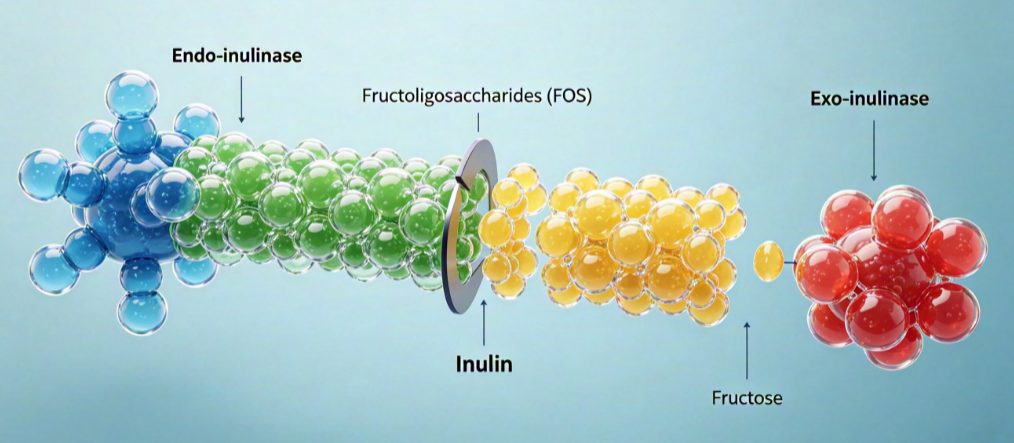
Endo-inulinase is an inulin-degrading enzyme belonging to the glycoside hydrolase family 32 (GH32). It specifically catalyzes the endohydrolysis of (2→1)-β-D-fructosidic linkages within inulin, a linear fructan polymer composed primarily of β-(2→1) linked D-fructose residues, typically terminated by a single glucose unit.
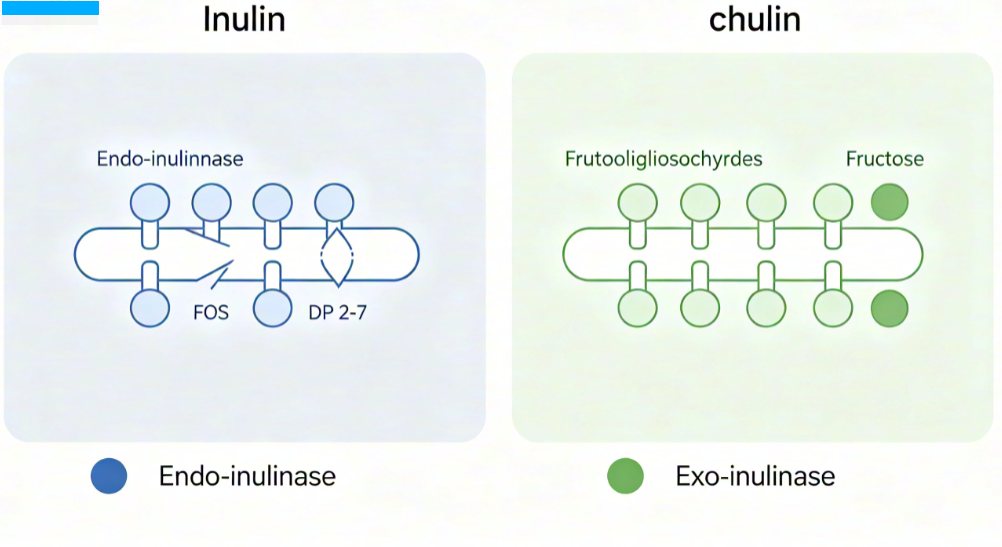
• Exo-inulinase (EC 3.2.1.80) attacks the terminal non-reducing ends of the inulin chain, releasing single fructose units.
• Endo-inulinase cleaves internal linkages randomly, producing a mixture of fructooligosaccharides (FOS) with varying degrees of polymerization (DP), typically ranging from DP 2 to DP 7 (e.g., kestose, nystose, and fructofuranosylnystose).
Sources
Endo-inulinase is produced naturally by a variety of microorganisms, including filamentous fungi (e.g., Aspergillus niger, Penicillium species), yeasts (e.g., Kluyveromyces marxianus), and some bacteria. Fungal sources are particularly prized for industrial production due to their high enzymatic activity and stability.
Biochemical Properties
- Molecular weight: Typically between 50–70 kDa
- Optimal pH: Slightly acidic to neutral (pH 4.5–6.5), depending on the source
- Optimal temperature: 50–60°C
- Isoelectric point: Usually in the range of 3.5–5.0
- Substrate specificity: Highly specific for β-(2,1) linkages; does not act on sucrose or other non-fructan polysaccharides.
2. Efficacy and Mechanism of Action
The Catalytic Mechanism
Endo-inulinase operates via a retaining mechanism common to GH32 enzymes. It utilizes two key catalytic residues – typically an aspartate and a glutamate – that function as a nucleophile and an acid/base catalyst. The enzyme recognizes a stretch of internal fructosyl units, binds the inulin chain, and hydrolyzes a glycosidic bond, adding a water molecule across the cleaved bond.
The random endo-action is critical. Instead of completely dismantling inulin into monomers (fructose), it generates a distribution of oligosaccharides, each containing 3–7 fructose units linked to a terminal glucose. This product profile is what confers unique functional properties.
Key Efficacy Parameters
- High specificity: Unlike non-specific invertases, endo-inulinase produces minimal free fructose, which is crucial for applications requiring low glycemic impact.
- Controllable reaction rate: By adjusting enzyme concentration, temperature, and reaction time, manufacturers can tailor the average DP of the resulting FOS mixture.
- Synergy with other enzymes: Endo-inulinase can be combined with exo-inulinase or glucose oxidase to fine-tune product sweetness and composition.
Comparative Advantage over Chemical Hydrolysis
Traditional acid hydrolysis of inulin yields a random mix of fructose, glucose, and FOS, often with undesirable byproducts (e.g., difructose anhydrides) and requiring downstream neutralization. Endo-inulinase offers:
- ✔ Mild reaction conditions (no acid or heat extremes)
- ✔ High product specificity (predominantly FOS)
- ✔ No byproduct formation
- ✔ Environmentally friendly (biodegradable, energy-saving).
3. Major Applications of Endo-Inulinase
The unique ability to convert chicory or artichoke-derived inulin into high-purity FOS makes endo-inulinase a cornerstone of the functional food, pharmaceutical, and feed industries.
📌 1. Production of Fructooligosaccharides (FOS) – The Primary Application
FOS are among the most thoroughly studied prebiotics. Endo-inulinase is the enzyme of choice for large-scale FOS manufacturing. The process is elegantly simple: a purified inulin solution (typically from chicory or Jerusalem artichoke) is incubated with immobilized or free endo-inulinase under controlled conditions. The resulting syrup contains 50–70% FOS, 10–20% sucrose, and small amounts of glucose and fructose. Further purification (e.g., chromatography or fermentation) yields high-purity FOS (≥95%).
🥗 2. Food and Beverage Industry
- Low-calorie sweeteners: FOS provides sweetness approximately 30–50% that of sucrose, with only 1.5–2.0 kcal/g (vs. 4 kcal/g for sugar). Ideal for diabetic-friendly and weight-management products.
- Texture and mouthfeel: FOS acts as a humectant and bulking agent in baked goods, dairy, and confectionery.
- Sugar reduction: In beverages, FOS masks off-notes of high-intensity sweeteners (e.g., stevia, monk fruit).
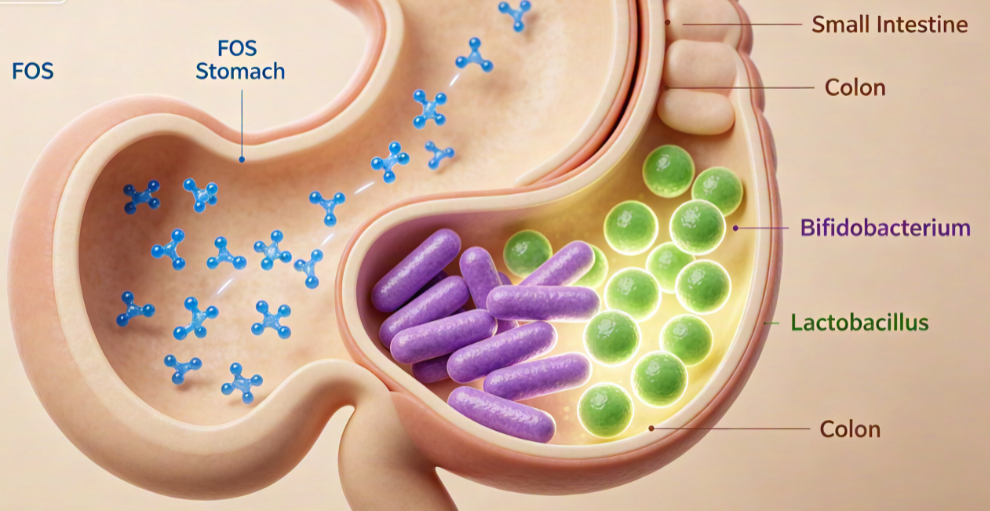
- Synbiotic products: Combined with probiotics (e.g., in yogurt or kefir), FOS enhances probiotic survival during shelf life.
Example products: Protein bars with reduced net carbs, children’s probiotic gummies, reduced-sugar chocolate and cookies.
💊 3. Pharmaceutical and Nutraceutical Applications
- Prebiotic supplements: Capsules or powders containing FOS derived via endo-inulinase are used to support gut health, alleviate constipation, and enhance mineral absorption (calcium and magnesium).
- Colon-targeted drug delivery: FOS can be incorporated into tablet coatings; colonic bacteria ferment the FOS, triggering drug release specifically in the large intestine.
- Immune modulation: Short-chain FOS have been shown to increase secretory IgA and modulate cytokine profiles, though this application often requires DP-controlled mixtures obtainable only via endo-inulinase.
🐓 4. Animal Feed
Endo-inulinase is used to process inulin-rich agricultural residues (e.g., chicory pulp) into FOS-enriched feed additives. In poultry and swine, dietary FOS reduces pathogenic Salmonella and E. coli while improving feed conversion ratios. In aquaculture, FOS enhances disease resistance in shrimp and tilapia.
⚡ 5. Biofuel and Biorefinery (Emerging Application)
While less common, endo-inulinase plays a role in the “inulin-to-ethanol” biorefinery. By first producing FOS (higher value product) with endo-inulinase, residual inulin can then be hydrolyzed by exo-inulinase and fermented to ethanol. This sequential process maximizes value from a single biomass source.
4. Technical Considerations & Industrial Parameters
Optimizing endo-inulinase performance requires careful control of reaction conditions. The table below summarizes typical process parameters:
| Parameter | Typical Range | Effect on Product / Process |
|---|---|---|
| Temperature | 50–60°C | Higher temp → faster reaction but shorter enzyme half-life |
| pH | 4.5–6.0 | Outside this range → reduced activity & stability |
| Substrate concentration | 10–30% (w/v) inulin | Higher concentration increases viscosity, may limit diffusion |
| Reaction time | 4–24 hours | Longer time → more complete hydrolysis, shifts DP to shorter FOS |
| Enzyme format | Free or Immobilized | Immobilization allows continuous operation & reusability |
Future trends & next-generation engineering
🧬 Engineered endo-inulinases
With altered product specificity (e.g., favoring DP 3 or DP 4 FOS) to target specific prebiotic effects.🔗 Co-immobilization
With glucose oxidase to simultaneously remove glucose, increasing FOS purity.🧪 Precision fermentation
Producing endo-inulinase directly in food-grade hosts (e.g., Bacillus subtilis) for streamlined production.📈 Process intensification
Membrane reactors and continuous FOS fractionation to reduce costs.5. Endo-Inulinase vs. Chemical Hydrolysis
| Aspect | Endo-Inulinase Hydrolysis | Acid Hydrolysis |
|---|---|---|
| Reaction conditions | Mild (50-60°C, pH 5-6) | High temperature, strong acid, corrosive |
| Product profile | Predominantly FOS (DP 2-7) | Random mix (high fructose + glucose + undesirable byproducts) |
| Byproducts | None (clean) | Difructose anhydrides, coloring compounds |
| Energy & environmental impact | Low energy, biodegradable, "green" | High energy, neutralization steps, waste disposal |
| Industrial control | Highly specific, reproducible DP | Difficult to control, inconsistent |
6. Commercial Relevance & Market Outlook
With the global prebiotics market projected to exceed USD 10 billion by 2030, endo-inulinase stands as a key technological driver. FOS produced via endo-inulinase is recognized as GRAS (FDA) and EFSA-approved for gut health claims, facilitating product innovation across functional beverages, medical foods, and senior nutrition. Immobilized endo-inulinase systems now enable continuous FOS manufacturing, improving yield and reducing production costs by up to 40% compared to batch-wise chemical processes.
7. Conclusion
Endo-inulinase is far more than a niche enzyme; it is a precision biocatalyst that unlocks the nutritional and functional potential of inulin. By selectively producing prebiotic fructooligosaccharides under mild, sustainable conditions, it enables food scientists and process engineers to formulate reduced-sugar, gut-friendly products ranging from yogurt to supplements. Its growing role in animal feed and emerging applications in biorefining further underscore its industrial relevance. As the global prebiotics market continues to expand, endo-inulinase will remain an indispensable tool for clean-label, health-driven food innovation.
For manufacturers and researchers alike, understanding and optimizing this enzyme is not just a technical exercise – it is a direct pathway to meeting modern consumer demands for functional, naturally derived ingredients.
© technical review — all content automatically wrapped for readability. References available upon scientific inquiry.


