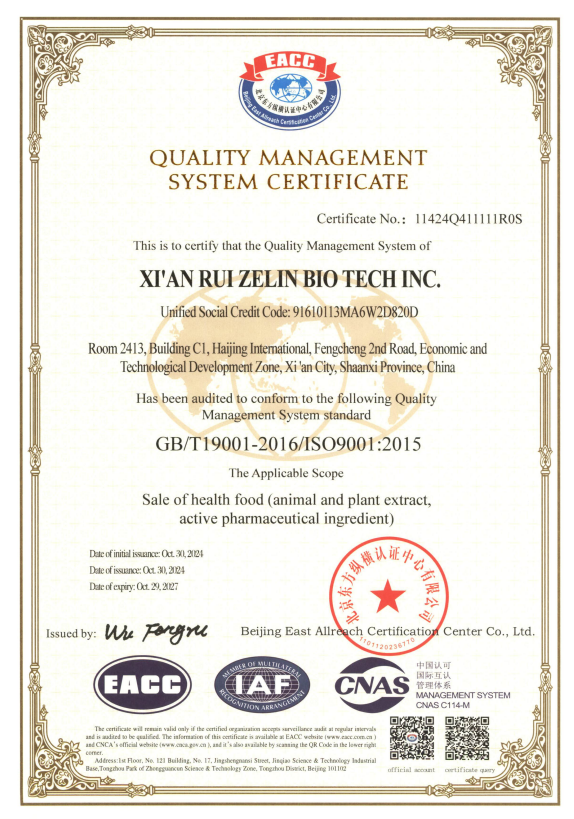


ISO Certificate Introduction
The purpose of ISO certification is to ensure the standardization, sustainability and safety of the operation process of the enterprise through system documents and on-site audits, and gradually improve
and improve the management level of the enterprise according to the standard, save costs, improve management efficiency and monitor risks. Our company -Xi'an Rui Zelin Bio Tech Inc. After sorting
out a lot of documents and field visits to offices and factories, it finally took 3-4 months to pass various audits and finally get the official certificate. The ISO certificate can enhance the competitive
advantage of enterprises in the market competition and enhance the brand value and market share of enterprises.
ISO 9001 certification is a rigorous quality management system implemented within a year of Ruizelin's operational experience.
The certification is developed by the International Organization for Standardization (ISO) to prove that enterprises have an effective quality management system in product design,
development, production, sales and service provision. T
he main principle of ISO 9001 certification is to ensure that all operations of a company are fully compliant with international standards through continuous improvement,
implementation and monitoring. This can help enterprises improve work efficiency, reduce costs, improve customer satisfaction, meet government standards and contract requirements, and thus improve the market competitiveness of enterprises.
To obtain ISO 9001 certification, companies need to complete the following steps:
1. Obtain documents: The enterprise must obtain quality management manuals, procedure files, process files, and work guides. These documents should meet the requirements of the ISO 9001 standard and should be in line with the actual operation of the enterprise.
2. Establish a quality management system: Enterprises need to implement a quality management system that complies with ISO 9001 standards and should ensure the cooperation of managers, employees and partners at all levels.
3. Appointment of internal auditors: The enterprise shall appoint one or more internal auditors to supervise, review and evaluate the quality management system of the enterprise, and coordinate among various departments.
4. Choose a certification body: enterprises need to choose an accredited certification body and apply for certification audit.
5. Audit preparation: enterprises need to prepare documents, data, records, etc., for the certification body audit.
6. Certification audit: The certification body will conduct an on-site audit to evaluate the quality management system of the enterprise. Upon completion of the audit, the certification body will provide an audit report.
7. Correction and improvement: Enterprises need to correct and improve the problems found in the audit process to ensure compliance with the requirements of ISO 9001 standards.
8. Obtain certification: If the enterprise meets the requirements of the ISO 9001 standard, it can obtain the ISO 9001 certification certificate after passing the audit.