


High-Quality L-Glutathione Reduced Backed by Comprehensive Third-Party
2026-03-27
L-Glutathione Reduced, a naturally occurring endogenous antioxidant renowned for its critical role in cellular protection, protein synthesis, DNA repair and oxidative stress resistance, has recently passed a series of rigorous third-party quality tests, with all key indicators fully meeting strict industry standards. The complete Certificate of Analysis for this batch of L-Glutathione Reduced provides detailed, quantified test data for every critical quality attribute, serving as an authoritative guarantee for its safety, purity and applicability in various fields. As a core document for product quality verification, the COA not only reflects the high quality of the product but also meets the strict compliance requirements of global supply chains for traceability and data transparency.
Exceptional Purity Achieved for Stable Bioactivity
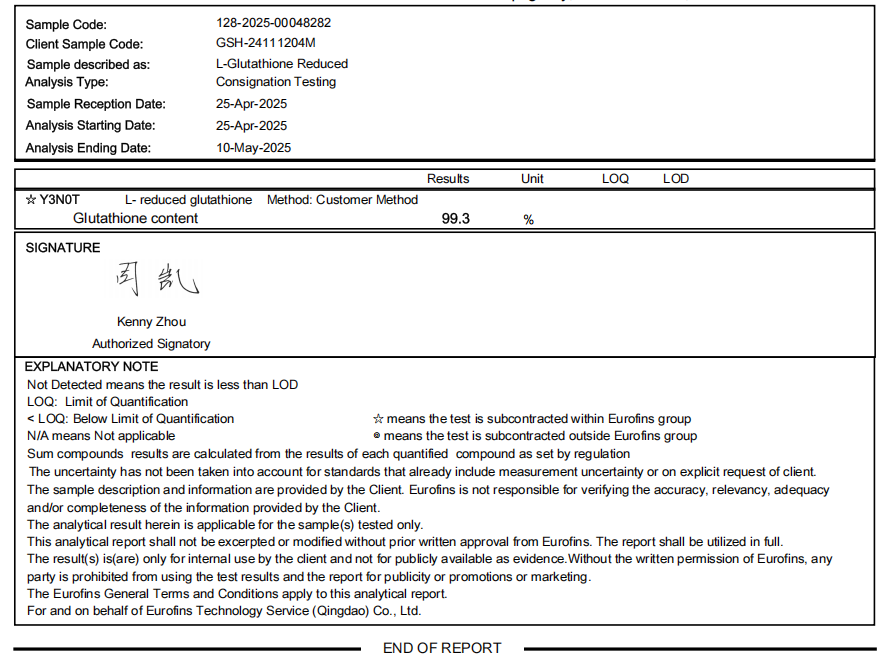
Purity is the cornerstone of L-Glutathione Reduced’s efficacy, and this batch has been tested to reach a purity level of 99.3% by a professional third-party laboratory using a customized precision detection method. This outstanding purity far exceeds the basic quality requirements of the industry, ensuring that the product can exert stable and reliable biological activity in a variety of application scenarios including health supplements, pharmaceutical raw materials and functional food ingredients. For downstream enterprises in the bioactive ingredient industry, accurate and high purity data is the key to controlling production processes, ensuring product consistency and maximizing the functional value of the final product, and this batch of L-Glutathione Reduced has achieved an excellent purity performance that can be fully verified.
Strict Heavy Metal Control Meets International Standards
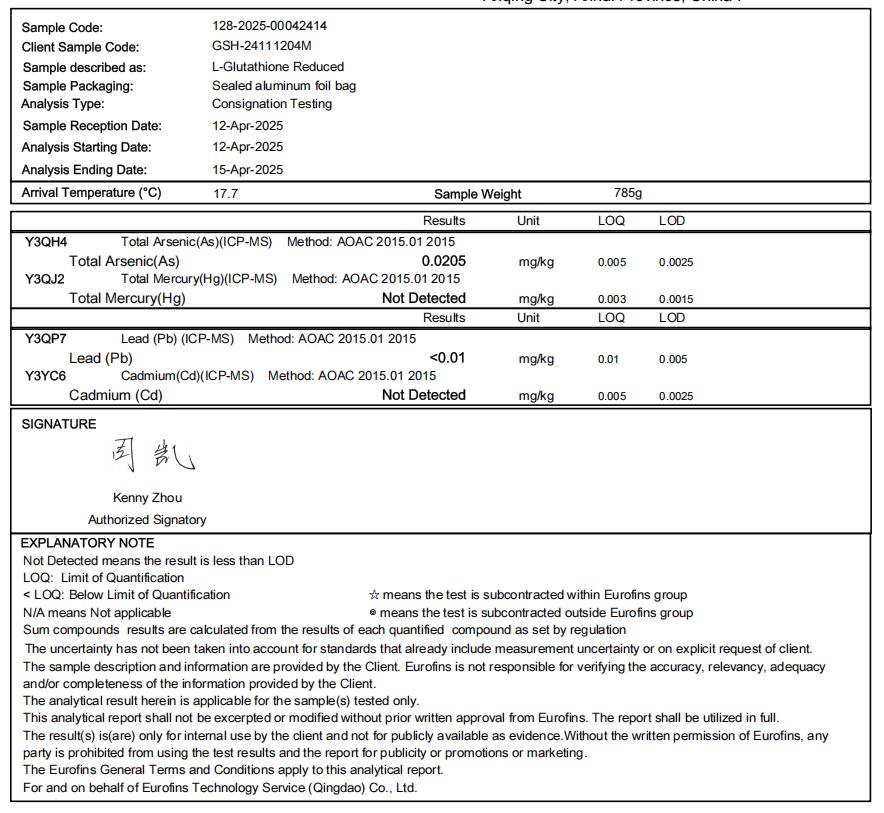
Heavy metal contamination is a major safety concern for raw material products, and this batch of L-Glutathione Reduced has undergone strict heavy metal detection via the advanced ICP-MS method in accordance with AOAC 2015.01 international standards. The test results show exceptional heavy metal control: the total arsenic content is only 0.0205 mg/kg, mercury and cadmium are not detected, and the lead content is less than 0.01 mg/kg, all meeting the strictest heavy metal control standards in the pharmaceutical and food industries.
The ultra-low heavy metal content fully proves that the product has undergone stringent raw material screening and high-precision production purification processes, completely eliminating heavy metal risks that may affect human health. For industries with high safety requirements such as pharmaceuticals, health food and functional ingredients, such excellent heavy metal control results are indispensable for product registration, market access and global supply chain audit.
Standardized Solvent Residue Compliance Reflects Advanced Production Technology
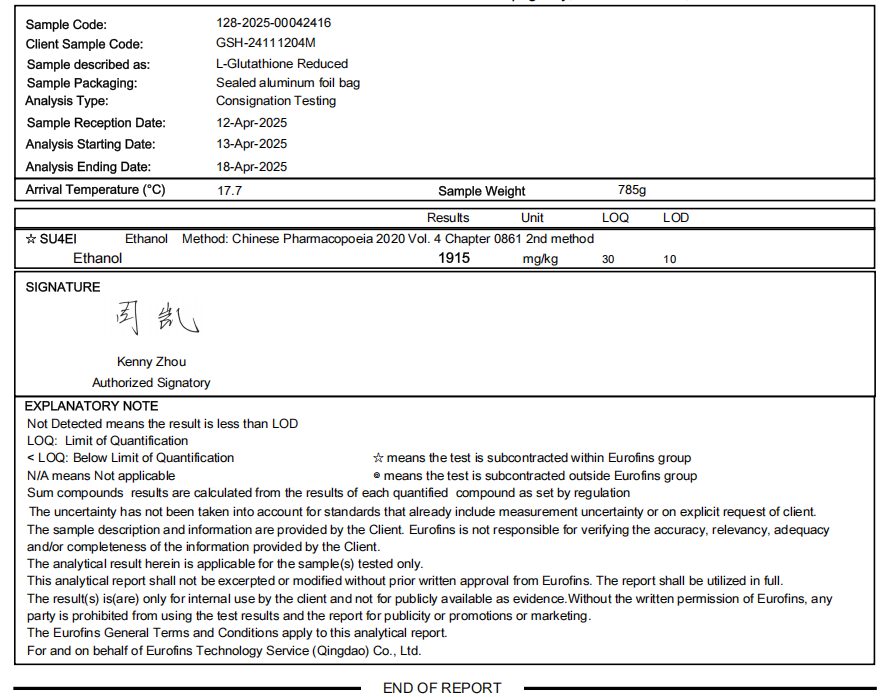
Solvent residue control is a key indicator reflecting the refinement level of production technology, and this batch of L-Glutathione Reduced has been tested for ethanol solvent residue in accordance with Chapter 0861, the second method of the Chinese Pharmacopoeia 2020 Volume 4. The detected ethanol residue is 1915 mg/kg, fully complying with the pharmacopoeia’s strict solvent residue limit regulations.
The standardized detection method and compliant test results confirm that the product’s solvent removal process is complete, standardized and efficient, eliminating the potential impact of residual organic solvents on product quality and safety. This indicator is particularly important for pharmaceutical-grade and food-grade raw materials, and the compliant solvent residue performance provides a solid quality basis for the product’s application in high-end pharmaceutical, health care and food fields.
Excellent Microbial Safety Performance for Food and Pharmaceutical Application
Microbial safety is a rigid quality requirement for all raw materials involved in human consumption and medical use, and this batch of L-Glutathione Reduced has completed a full set of microbial testing in accordance with the latest national food safety standards (GB series). The test results show excellent microbial control: the aerobic plate count is only 10 cfu/g, coliforms, moulds and yeasts are all less than 10 cfu/g, and pathogenic bacteria such as Salmonella and Staphylococcus aureus are not detected in the 25g sample test.
All microbial detection items adopt the latest national standard methods, including GB 4789.2-2022 for aerobic plate count and GB 4789.4-2024 for Salmonella detection. The outstanding microbial safety results prove that the product has implemented strict aseptic control in the whole process of production, packaging, storage and transportation, and fully meets the stringent microbial limit requirements of food and pharmaceutical raw materials. For downstream manufacturers, this excellent microbial safety performance can effectively reduce the quality control risk of the production process and ensure the safety and stability of the final product.

Authoritative Third-Party COA Serves as a Reliable Quality Passport
Previous News: Acesulfame-K: The Sweet Revolution That Balances Taste and Wellness
Next News: Feeling stuck in a muscle-building plateau? You might be missing HMB-Ca.


