


Melatonin Your Complete Guide to Better Sleep
Melatonin
In today's fast-paced modern life, more and more people are troubled by insomnia, difficulty falling asleep, and disrupted sleep schedules. As a substance closely related to sleep, melatonin has gradually come into the public eye. So, what exactly is melatonin? What benefits does it offer? And how should it be used? This article will explore these questions in detail.

1 What Is Melatonin?
Melatonin is a natural hormone secreted by the pineal gland, a small endocrine gland located deep within the brain. Its chemical name is N-acetyl-5-methoxytryptamine, and it is synthesized from the amino acid tryptophan through a series of enzymatic reactions. Despite its name, melatonin is not related to the skin pigment melanin — they are entirely different substances.
The primary function of melatonin is to regulate the body's circadian rhythm, commonly known as the biological clock. This internal timing system controls not only the sleep-wake cycle but also influences body temperature, hormone release, blood pressure, and metabolism. Melatonin essentially tells the body “when it's time to sleep and when it's time to wake up.”
Melatonin secretion follows a distinct circadian pattern. During the day, light exposure — especially blue light from sunlight and electronic screens — suppresses its production. As darkness falls, the pineal gland begins to release melatonin into the bloodstream. Levels typically begin to rise around 9 to 10 p.m., reach their peak between 2 and 3 a.m., and then gradually decline toward morning. Because of this pattern, melatonin is often called the “hormone of darkness” or the “vampire hormone.”
Several factors can disrupt this natural rhythm. Aging is one of them: melatonin production tends to decline significantly after age 40 and continues to decrease with age. Other factors include staying up late, excessive exposure to artificial light at night, jet lag from cross-time-zone travel, and irregular work schedules such as night shifts. When melatonin secretion is reduced or its rhythm is disturbed, people may experience difficulty falling asleep, frequent nighttime awakenings, early morning waking, and overall poor sleep quality.

2 The Benefits of Melatonin
Improving Sleep Quality
The most well-known benefit of melatonin is its ability to help people fall asleep. Research has shown that melatonin can shorten sleep latency (the time it takes to fall asleep), reduce the number of nighttime awakenings, and improve overall sleep efficiency. It is especially effective for insomnia caused by circadian rhythm disruption, such as delayed sleep phase syndrome, where a person's natural sleep time is pushed far later than desired.
Regulating Jet Lag
For people who frequently travel across multiple time zones, melatonin can be a valuable tool. Jet lag occurs when the body's internal clock is out of sync with the local time at the destination, leading to daytime fatigue, nighttime insomnia, difficulty concentrating, and digestive issues. Taking melatonin at the appropriate time in the new time zone can help reset the biological clock more quickly and reduce these symptoms.
Relieving Sleep Problems Caused by Shift Work
Night-shift workers, rotating-shift personnel, and medical staff often struggle with sleep disorders because their work schedules conflict with their natural circadian rhythms. Melatonin supplementation can help adjust the biological clock and improve daytime sleep quality for these individuals, making it easier to get adequate rest despite an unconventional schedule.
Antioxidant Effects
Beyond its role in sleep regulation, melatonin is a powerful antioxidant. It can scavenge free radicals — unstable molecules that damage cells — and stimulate the production of antioxidant enzymes. This protective effect may help slow the aging process, support the immune system, and reduce oxidative stress in various tissues, including the brain.
Supporting Mood Regulation
Some research suggests that melatonin may play a positive role in mood regulation. Because sleep and mood are closely interconnected, improving sleep quality through melatonin supplementation may indirectly help relieve symptoms of mild anxiety and depression. However, this effect is still being studied and requires more clinical evidence before firm conclusions can be drawn.
Potential Additional Benefits
Preliminary studies have explored melatonin's potential role in other areas, including migraine prevention, gastroesophageal reflux relief, and even certain aspects of immune function. While these findings are promising, they are not yet definitive, and melatonin should not be used as a primary treatment for these conditions without medical guidance.
3 Applications of Melatonin
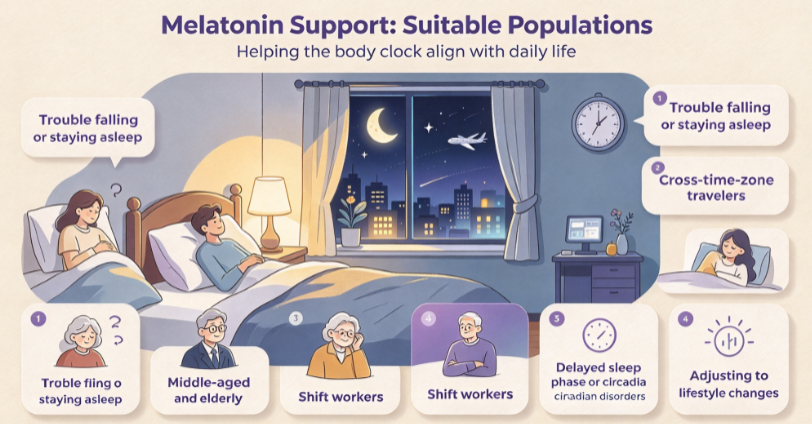
Suitable Populations
- People who have difficulty falling asleep, experience light sleep, or wake up frequently during the night
- Cross-time-zone travelers, including frequent flyers and airline crew
- Shift workers such as nurses, doctors, security personnel, and factory workers on rotating schedules
- Middle-aged and elderly people whose melatonin secretion has naturally declined with age
- Individuals with delayed sleep phase syndrome or other circadian rhythm disorders
- People who need to adjust their sleep-wake rhythm due to lifestyle changes
How to Use
Melatonin is widely available in various forms, including tablets, capsules, oral liquids, sublingual tablets, and even gummies. It is generally recommended to take it 30 minutes to 1 hour before the desired bedtime. A typical starting dose is 1 to 3 milligrams, though the optimal dosage can vary significantly from person to person. Some individuals respond well to as little as 0.5 milligrams, while others may need higher doses. It is always best to start with a low dose and adjust gradually under the guidance of a healthcare professional.
For jet lag, the timing of melatonin intake is particularly important. Generally, it is taken at the target bedtime in the new time zone for several consecutive nights. For shift workers, melatonin is usually taken before the desired sleep period, whether that is during the day or at night.
Precautions
- Long-term high-dose use is not recommended, as it may suppress the body's natural melatonin production and affect the sensitivity of melatonin receptors.
- Pregnant women, nursing mothers, children, and patients with autoimmune diseases should use melatonin with caution or avoid it unless advised by a doctor.
- Mild side effects may include dizziness, drowsiness, headache, nausea, or vivid dreams. These effects are usually temporary and resolve on their own.
- Avoid taking melatonin together with alcohol, sedative-hypnotic drugs, or other sleep medications, as this may increase sedation and impair alertness.
- Do not drive or operate heavy machinery after taking melatonin.
- Melatonin is classified as a health food or dietary supplement in many countries and cannot replace prescription medication for treating underlying sleep disorders or other medical conditions.
- If sleep problems persist for more than a few weeks, it is important to consult a healthcare professional to rule out underlying causes such as sleep apnea, restless legs syndrome, or thyroid disorders.
🌙 The Importance of Sleep Hygiene
Melatonin works best when combined with good sleep habits. These include maintaining a consistent sleep schedule, creating a dark, quiet, and cool sleep environment, limiting screen time before bed, avoiding caffeine and heavy meals in the evening, and engaging in regular physical activity during the day. Melatonin is not a substitute for healthy sleep practices — it is a supplement that supports them.
4 Conclusion
As an important substance for regulating sleep, melatonin plays a positive role in improving difficulty falling asleep, adjusting the biological clock, and supporting overall sleep health. It is a natural hormone that the body produces on its own, and supplementing it in appropriate ways can be beneficial for many people dealing with sleep challenges. However, scientific use is key. Understanding the right dosage, timing, and precautions can make a significant difference in its effectiveness and safety.
If you are struggling with sleep problems, it is advisable to first understand your own situation and seek professional guidance when necessary. Sleep is the foundation of health, and taking a thoughtful approach to melatonin use can help you make the most of this remarkable hormone.


