

Thyroid Powder: A Scientific Review from Traditional Glandular Preparation to Standardized Ingredient
Thyroid Powder:
A Scientific Review from Traditional Glandular Preparation to Standardized Ingredient
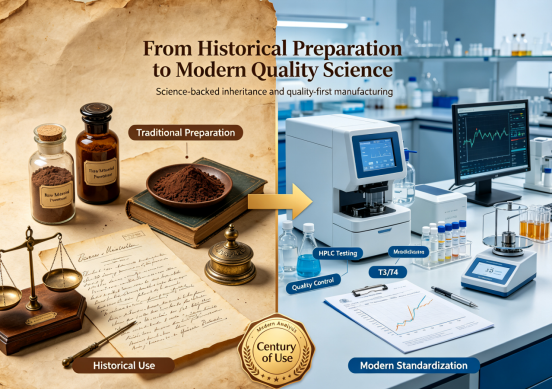
In the field of biopharmaceutical raw materials, Thyroid Powder occupies a uniquely significant position. Derived from the thyroid glands of food‑source animals such as pigs, cattle, and sheep, it is refined through processes including removal of connective tissue and fat, mincing, dehydration, defatting, and low‑temperature drying. As a naturally sourced thyroid hormone complex, it contains both thyroxine (T4) and triiodothyronine (T3), and has been used in replacement therapy for hypothyroidism for over a century.
Yet discussion surrounding thyroid powder has never ceased – it is both one of the earliest hormone replacement therapies in history and one of the most challenging raw materials in today's standardized production and quality control landscape. How should we understand its value and its limitations? Let's begin with its essence.

Over a Century of Clinical Practice: The Historical Standing of Thyroid Powder
The clinical application of thyroid powder dates back to the late 19th century. In 1891, sheep thyroid extract was first used to treat myxoedema, pioneering the era of hormone replacement therapy. Subsequently, desiccated porcine thyroid preparations (such as Armour Thyroid) became routine clinical choices for hypothyroidism of various causes, including cretinism, myxoedema, and other hypothyroid states.
Compared with synthetic levothyroxine, thyroid powder's distinctive feature is that it provides both T4 and T3, in a ratio of approximately 4:1. This ratio is closer to the physiological state, leading some patients to report subjective symptom improvements during thyroid powder therapy – including better sleep, attention, mood, and energy levels. A randomized, double‑blind crossover study showed that 48.6% of patients preferred thyroid powder over levothyroxine alone.
The Core Challenge: Biological Variability and Standardization
Despite its deep historical roots, the central issue facing thyroid powder has always been the uncontrollable batch‑to‑batch hormone content.
Thyroid powder is sourced from animal glands, and natural differences in T3 and T4 content exist between individual animals and between raw material batches. This variability complicates precise clinical dose adjustment. Taking Armour Thyroid as an example, although manufacturers test T4 and T3 content in both raw materials and finished products to ensure batch consistency, different brands and sources of thyroid powder may still differ significantly in potency.
Research data indicate a consistent correlation between the T3 content in thyroid powder and "goitrogenic prevention activity," and this correlation is independent of T4 levels. This suggests that the T3 component may be more decisive than T4 when assessing the biological potency of thyroid powder.
In addition, the complexity of dosage labelling adds further difficulty. Thyroid powder is typically labelled in "grains," with 1 grain equal to approximately 60–65 mg, providing about 38 µg T4 and 9 µg T3. This measurement system does not directly correspond to the microgram‑level labelling of synthetic hormones, posing challenges for dose conversion and precise titration.
Safety Considerations: Natural Does Not Mean Harmless
The "natural source" label of thyroid powder can easily create an illusion of "greater safety," but this is not the case.
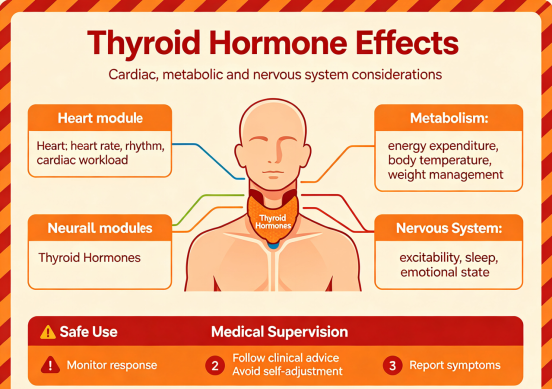
Thyroid hormones act extensively throughout the body, influencing virtually every organ system – from basal metabolic rate regulation to cardiac function and nervous system excitability. Excessive thyroid hormone intake can cause exogenous hyperthyroidism, manifesting as tachycardia, arrhythmia, hypertension, tremor, anxiety, insomnia, and weight loss. In the elderly and patients with heart disease, excessive thyroid hormone may even trigger angina and myocardial infarction.
A retrospective study published in 2024 analysed 77 patients receiving thyroid powder therapy, with a mean treatment duration of 77.5 months. Results showed that 19.5% of patients experienced new cardiovascular events during treatment, including hypertension, coronary heart disease, atrial fibrillation, and type 2 diabetes. Although the researchers emphasized that a direct causal link to thyroid powder remains unclear, this data reminds us: long‑term use of thyroid powder requires strict monitoring.
More concerning is that some thyroid supplements sold through unregulated "health food" channels have been found to contain bioactive thyroid hormones with highly variable content. Mayo Clinic researchers tested 10 commercially available thyroid support supplements, 9 of which contained animal thyroid hormones. Some products contained T3 at over 50% of the body's daily endogenous production, and T4 at up to twice the adult daily requirement. The use of these products without medical supervision poses significant health risks.
Quality Control: The Standardization Path from Raw Material to Finished Product
Faced with the challenges of biological variability, modern thyroid powder raw material production has established a relatively comprehensive quality control system.
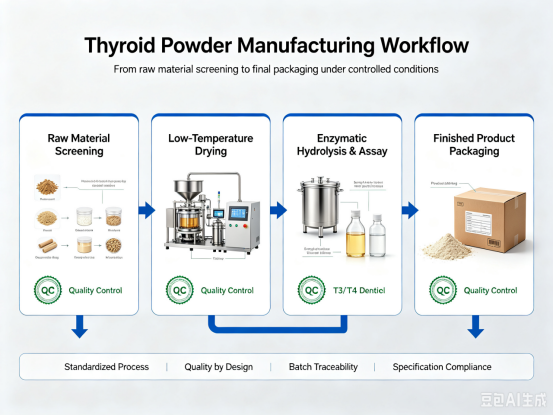
On the raw material side, thyroid powder production requires strict screening of animal sources, ensuring raw materials come from quarantine‑approved food animals. In the production process, steps such as removal of connective tissue and fat and low‑temperature drying (below 60°C) are designed to preserve hormone activity while removing impurities.
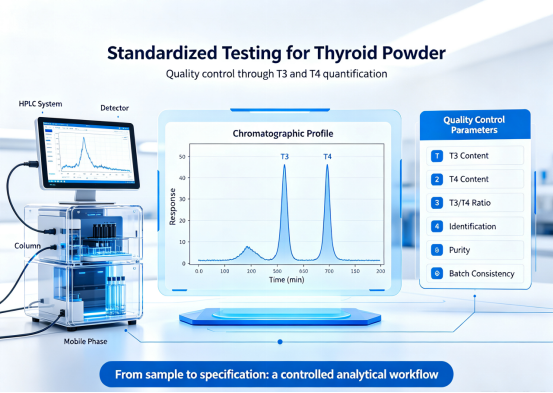
On the testing side, Pronase enzymatic digestion has been proven to be an effective method for releasing T3 and T4 from thyroid powder, superior to other enzymatic systems. Quantification of the released T3 and T4 through chemical analysis methods enables potency assessment of both raw materials and finished products.
However, the industry still faces a fundamental challenge: the correspondence between biological potency and chemical content. The clinical efficacy of thyroid powder depends not only on total T3/T4 content but also on hormone release rate, absorption efficiency, and individual variation. This is also why thyroid powder has never been formally approved by the US FDA, but rather continues due to its use history predating the FDA.
A Rational Perspective: Positioning and Future of Thyroid Powder
In current clinical practice, synthetic levothyroxine (LT4) is recommended by the American Thyroid Association (ATA) as the first‑line treatment for hypothyroidism. Thyroid powder is no longer regarded as the preferred option, primarily due to its dose inconsistency and T3 content being higher than the physiological ratio.
However, this does not mean thyroid powder has no value. For some patients with persistent symptoms under LT4 therapy, thyroid powder may offer an alternative. The key is that any use must be conducted under strict medical supervision, with regular monitoring of TSH, free T4, and total T3 levels, and timely dose adjustment.
For raw material suppliers and formulation manufacturers, quality control capability for thyroid powder is a reflection of core competitiveness. Batch‑to‑batch consistency, stability of the T3/T4 ratio, and complete testing reports are the foundation for winning downstream customer trust.