


The Health Code of Cruciferous Vegetables: How Glucoraphanin Moves from Lab to Daily Life
The Health Code of Cruciferous Vegetables:
How Glucoraphanin Moves from Lab to Daily Life
As nutritional science continues to advance, people are no longer satisfied with vague notions of "eating this is good for you." Instead, they are asking: Which specific compound is responsible? And how does it actually work?
Glucoraphanin – a natural bioactive compound found predominantly in broccoli seeds and sprouts – offers a compelling answer to these questions. It is rapidly becoming a focal point at the intersection of functional foods and nutritional science.
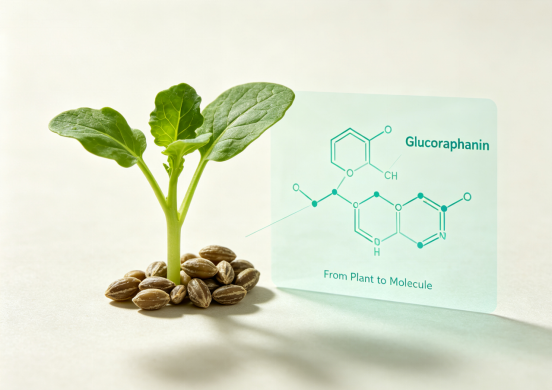
From Broccoli to Bioactive Molecule: Decoding Glucoraphanin
Chemically known as 4-methylsulfinylbutyl glucosinolate, Glucoraphanin is a naturally occurring glucosinolate compound. It is abundant in cruciferous vegetables such as broccoli and cabbage, with particularly high concentrations in broccoli seeds and young sprouts.
However, Glucoraphanin itself is not the final "active executor." When plant cells are disrupted (e.g., through chewing or cutting), the plant's endogenous enzyme myrosinase is activated, hydrolyzing Glucoraphanin into Sulforaphane – the true bioactive molecule that exerts potent biological effects. Moreover, even when myrosinase is inactivated during cooking, Glucoraphanin can still be converted to Sulforaphane by the gut microbiota, ensuring continued activity in the body.
This precise "precursor → conversion → action" mechanism makes Glucoraphanin a highly promising molecule in natural product research.
Nrf2 Activation: The Core Pathway of Glucoraphanin
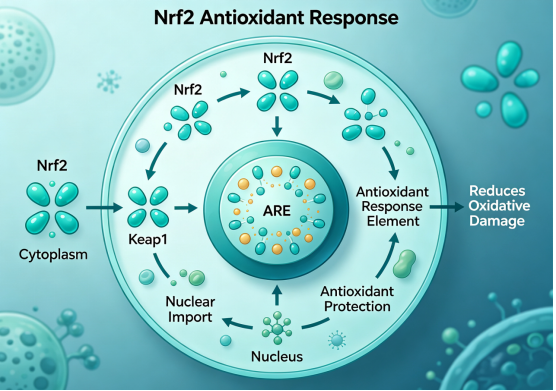
What sets Glucoraphanin apart from many other natural compounds is that its conversion product – Sulforaphane – is recognized as one of the most potent natural activators of Nrf2 known to date.
Nrf2 (Nuclear factor erythroid 2‑related factor 2) is a transcription factor that regulates the expression of cellular antioxidant and detoxification genes. Once activated, Nrf2 translocates to the nucleus and triggers the expression of a cascade of protective genes, including antioxidant enzymes and Phase II detoxification enzymes, helping cells defend against oxidative stress and toxic insults.
Studies have confirmed that Sulforaphane, through Nrf2 activation, induces the expression of multiple cytoprotective proteins – including NQO1 (quinone oxidoreductase), GST (glutathione S‑transferase), and GCLC (glutamate‑cysteine ligase catalytic subunit) – thereby enhancing the body's defence against oxidative damage and chemical toxins.
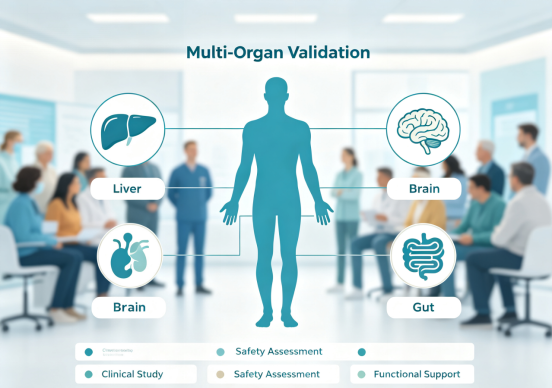
Notably, Nrf2 is expressed in virtually all human tissues – including the kidneys, muscles, lungs, heart, liver, and brain. This widespread distribution gives Glucoraphanin the potential to modulate systemic gene expression, which explains its remarkably broad range of effects.
Research Evidence: Multi‑Dimensional Validation from Lab to Clinic
Research on Glucoraphanin has expanded from basic science to human clinical trials, spanning multiple health domains.
Accelerating Toxin Excretion
In a human intervention study conducted in Qidong, Jiangsu Province, China, volunteers who consumed a broccoli sprout beverage rich in Glucoraphanin showed significantly increased urinary excretion of the potential carcinogens benzene and acrolein – by 61% and 23%, respectively. These findings confirm the real‑world value of Glucoraphanin in accelerating the clearance of harmful substances from the body.
Metabolic Health Support
An animal study published in 2024 showed that Glucoraphanin supplementation significantly improved hepatic steatosis in high‑fat diet‑induced obese mice, reducing plasma transaminase levels and hepatic triglyceride accumulation. Mechanistic analysis revealed that this effect was associated with Glucoraphanin's suppression of fatty acid synthesis genes and pro‑inflammatory chemokine expression, as well as attenuation of the inflammatory phenotype in liver macrophages. Another study also confirmed that Glucoraphanin improves high‑fat diet‑induced obesity‑related markers by modulating the gut microbiota and its metabolites.
Mental Health & Cognitive Function
Given its antioxidant and anti‑inflammatory properties, Glucoraphanin has shown promise in the management of psychiatric disorders and cognitive impairment. Several Chinese research institutions have initiated clinical trials on conditions including schizophrenia, autism spectrum disorder, and depression. For example, a clinical intervention conducted by Xiangya Hospital of Central South University confirmed that Glucoraphanin improved clinical symptoms in children with autism. In the cognitive domain, relevant clinical studies have also provided preliminary directions for Glucoraphanin's potential application in Alzheimer's disease intervention.
From Table to Supplement: The Application Horizon of Glucoraphanin
With its well‑defined mechanisms of action and extensive research validation, Glucoraphanin is now moving from academic research to real‑world applications.
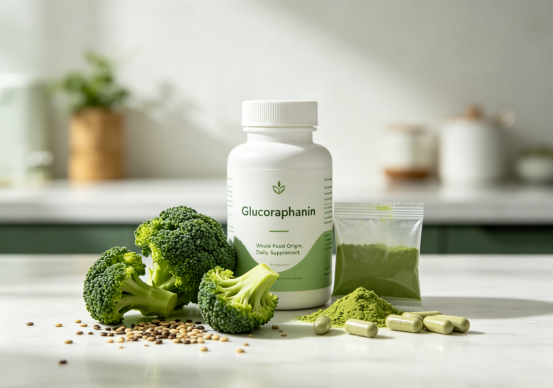
In the functional food sector, Glucoraphanin‑rich broccoli sprout powders and extracts are progressively entering the market. A 2026 human intervention study used broccoli soup containing 452 µmol of Glucoraphanin, providing a scientific reference for dietary supplementation.
In dietary supplements, Glucoraphanin has become an ideal choice for consumers pursuing "clean‑label" products, thanks to its natural origin and favourable safety profile. Compared with synthetic Nrf2 activators, naturally derived Glucoraphanin offers a clear safety advantage.
Globally, more than 100 clinical trials related to Glucoraphanin have been registered on ClinicalTrials.gov, covering cancer prevention, metabolic diseases, neuropsychiatric disorders, and many other fields. This substantial body of research underscores the strong scientific consensus regarding Glucoraphanin's immense potential.
Embracing the Power of Natural Protection
It is not a drug, yet it carries the precision of a pharmaceutical agent. It is derived from nature, yet it withstands the most rigorous scientific scrutiny.
In today's era of proactive wellness, Glucoraphanin offers us a gentle yet powerful option – to protect cellular health and vitality by activating the body's own defence systems, rather than through exogenous intervention.
This, perhaps, is the future direction of nutritional science.


