


“Awaken” Natural Flavor, Empower Clean Production: Amylase’s Revolutionary Power in the Additives Sector
“Awaken” Natural Flavor, Empower Clean Production:
Amylase’s Revolutionary Power in the Additives Sector
In today’s food industry and biomanufacturing, consumers’ pursuit of “natural,” “clean-label,” and “texture-friendly” products has reached an all-time high. How can we maintain product texture, extend shelf life, and enhance flavor while reducing chemical additives?
The answer may lie in nature’s most exquisite pair of “scissors” — Amylase.
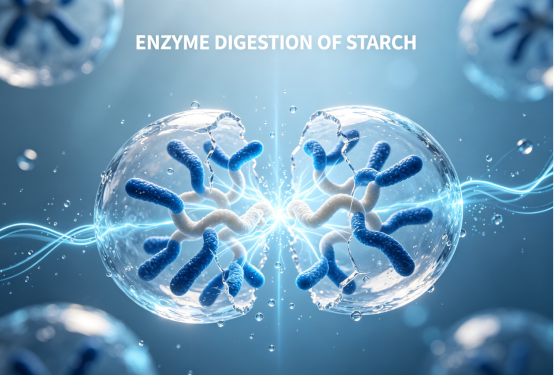
Traditionally, amylase has been simplistically viewed as “starch-to-sugar” converter. Yet in modern additive applications, specific amylases — including α‑amylase, β‑amylase, glucoamylase, and thermostable amylases — have long surpassed this single function.
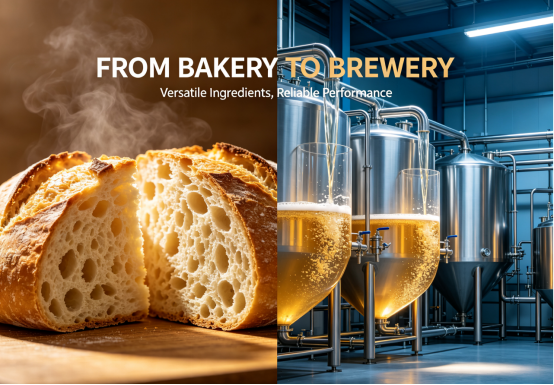
- Texture magician: In baking, amylase acts on damaged starch in flour, generating dextrins and a small amount of sugars. This not only improves dough machinability, but also, through the Maillard reaction, gives bread a golden, appealing crust while retarding staling and keeping the crumb soft for longer.
- Brewing’s soul driver: In beer and fermented beverages, amylase precisely controls the maltose/glucose ratio during saccharification, directly influencing fermentation efficiency and the final body and mouthfeel of the alcohol.
- Reduced sugar, full taste: For low‑sugar trends, specific amylases efficiently convert starch into functional syrups with a mild sweetness, helping manufacturers cut sucrose addition while preserving a rich “sweetness profile.”
With ever‑stricter environmental regulations, the biocatalytic advantages of amylase are irreplaceable:
- Mild & efficient: Compared with traditional acid hydrolysis, enzymatic hydrolysis operates under mild conditions (moderate temperatures, near‑neutral pH), dramatically reducing equipment corrosion costs and energy consumption.
- Fewer by‑products: High substrate specificity means virtually no side reactions, resulting in high‑purity products and simpler downstream purification — significantly lowering wastewater discharge.
- Clean‑label passport: In final product labelling, amylase is generally classified as a processing aid (no declaration required) or simply listed as “enzyme preparation” — perfectly aligning with consumers’ desire for “no chemical additives.”

We understand that batch‑to‑batch consistency is critical in industrial production. Our additive‑grade amylase products offer the following core advantages:
- Ultimate stability: Through specialised immobilisation, our enzymes effectively resist temperature fluctuations and metal‑ion interference during processing, ensuring ≥99% batch‑to‑batch reproducibility.
- High purity, low odour: Advanced membrane filtration removes contaminating proteins and pigments, delivering a final product that is odourless and brilliantly clear — especially suited for premium transparent beverages and refined foods.
- Flexible application solutions: Our technical team not only supplies enzymes but also provides full‑process parameter optimisation — from lab‑scale trials to industrial production — and matches the optimal formulation for your specific substrate (e.g., corn, wheat, or cassava starch).

In the world of additives, amylase is no cold chemical code. It is a biological messenger that delivers natural cereal notes, soft textures, and pure colours.
We are committed to using cutting‑edge enzyme technology to help you outperform in a fiercely competitive market — in a greener, more economical way — and to build benchmark products that win consumer trust.
Welcome to contact us for your tailored enzymatic solution.


