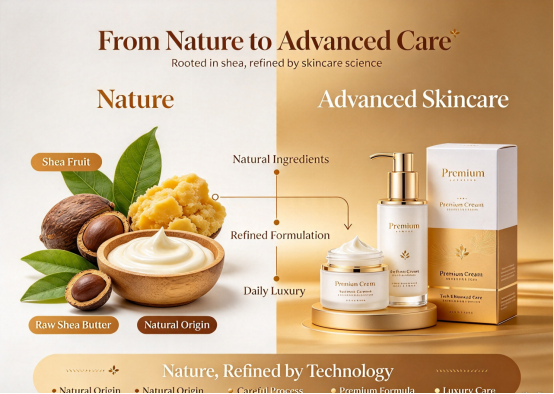


The Golden Nourishment of Africa How Shea Butter Rose from Traditional Skincare to Global Beauty Stardom
The Golden Nourishment of Africa:
How Shea Butter Rose from Traditional Skincare to Global Beauty Stardom
In the dazzling array of skincare ingredients, few can match Shea Butter in bridging thousands of years of history, crossing continental boundaries, and firmly rooting itself in the centre of the modern global beauty industry.
From the vast savannas south of the Sahara to the high‑end cosmetic laboratories of Paris, New York, and Tokyo, this natural fat extracted from the shea tree fruit is writing a legend of nature and science intertwined with its irreplaceable deep‑nourishing power.
What exactly is its magic? Let's start with its origins.
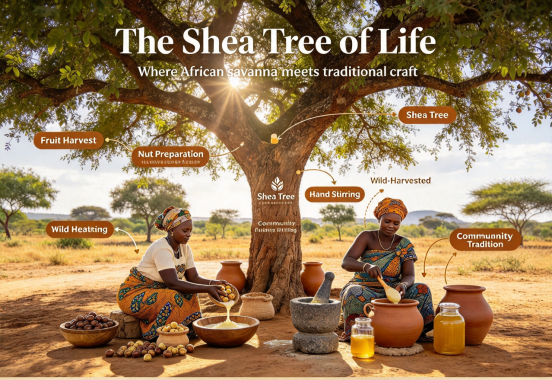
From Africa's "Tree of Life" to Golden Fat
Shea Butter is extracted from the kernels of the shea tree (Vitellaria paradoxa). These trees grow primarily in the dry savanna regions from West to East Africa and can live for centuries. Locally, the shea tree is called the "Tree of Life," and its fruit and oil have been widely used in cooking, medicine, and skincare for thousands of years.
The traditional extraction process is remarkably pure: after harvesting, the fruit pulp is removed, and the kernels are sun‑dried, roasted, and ground into powder. Water is added, and the mixture is boiled and constantly stirred until the oil naturally floats to the surface. After filtering and cooling, a natural solid fat ranging from pale yellow to ivory is obtained.
Modern industry further purifies and removes impurities through cold pressing or refining processes, while maximally preserving its active components. Whether traditional handmade or modern standardised production, the core value of Shea Butter remains unchanged – exceptional moisturising and repairing capability.
Decoding "Women's Gold": A Rich Composition Profile
Shea Butter is known in Europe as "Women's Gold" – not only for its colour but also for its outstanding value to the skin. This solid fat possesses a highly unique chemical composition:
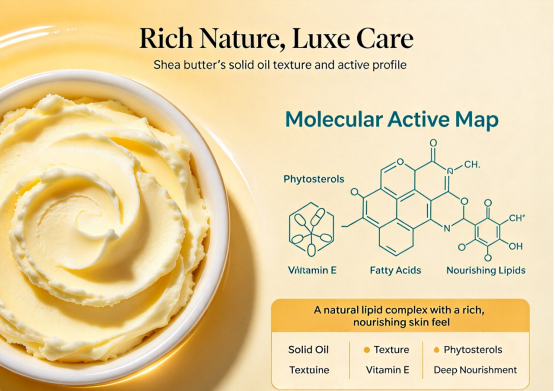
- High Unsaponifiables Content: This is the core distinction between Shea Butter and other plant oils. Unsaponifiables typically account for about 8% to 10%, including phytosterols, triterpene alcohols, tocopherols (vitamin E), and phenolic compounds. These components give it powerful anti‑inflammatory, antioxidant, and cell‑regenerating capabilities.
- Rich Fatty Acid Profile: Composed mainly of oleic acid (approx. 40–60%), stearic acid (approx. 20–50%), linoleic acid, and palmitic acid. This high proportion of stearic and oleic acids makes it solid at room temperature but allows it to melt quickly upon contact with body temperature, forming a breathable, long‑lasting moisture‑locking protective film.
- Natural Vitamins A and E: Vitamin A helps improve skin elasticity and texture, while vitamin E is a classic antioxidant that helps defend against free radical damage.
It is precisely this dual mechanism of "fatty acid film‑forming + deep repair by unsaponifiables" that makes Shea Butter an impeccable foundational ingredient in skincare formulations.
The "Multi‑Talented" Skincare Star: From Deep Moisture to Barrier Repair
In dermatological science, the efficacy of Shea Butter has been widely validated. It is suitable for almost all skin types, excelling particularly in the following core areas:
Deep Moisture & Barrier Repair
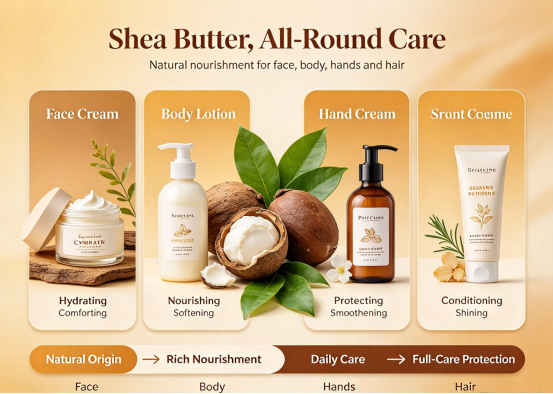
The fatty acids abundant in Shea Butter can mimic the skin's natural lipids, quickly filling the intercellular gaps of the stratum corneum and reducing transepidermal water loss (TEWL). Meanwhile, its triterpene alcohols possess anti‑inflammatory properties that soothe dry, red, and irritated skin, making it an excellent ingredient for repair creams, body lotions, and hand creams.
Anti‑Ageing & Skin Texture Improvement
High concentrations of unsaponifiables and antioxidants such as vitamin E help delay the skin ageing process and reduce the appearance of fine lines and wrinkles. Long‑term use can significantly enhance skin softness and radiance.
Soothing Eczema & Sensitive Skin
Multiple studies have shown that cinnamic acid derivatives in Shea Butter have mild anti‑inflammatory effects. Due to its extremely low allergenicity and excellent tolerance, it is often added to baby skincare products and formulas for sensitive and eczema‑prone skin.
Hair & Scalp Care
Beyond skincare, Shea Butter is also a star in hair care. It forms a protective film on the hair surface, smoothing frizz and locking in moisture. For dry, damaged hair and itchy scalps, leave‑in conditioners and hair masks containing Shea Butter are highly effective.
Market Trends: The Dual Engine of Clean Beauty and Sustainability
Market data indicates that the global Shea Butter market is in a steady expansion phase. As the "Clean Beauty" and "natural ingredients" trends deepen, consumer demand has surged for raw materials that are transparently sourced, purely composed, and possess tangible repairing efficacy.
Furthermore, sustainability and ethical sourcing have become core issues affecting the Shea Butter supply chain. Since shea trees rely mainly on wild growth, harvesting and initial processing are often carried out by local women's cooperatives in Africa. More and more international brands are focusing on "Fair Trade" certification and "women's empowerment" projects, which not only ensure long‑term stable supply of raw materials but also give products higher ethical added value.
At the same time, the debate over refined vs. unrefined Shea Butter continues. Unrefined (Raw) Shea Butter retains more natural plant aroma and active components, highly favoured by handmade soap and natural skincare enthusiasts. Refined Shea Butter, having removed odours and impurities, is whiter and more stable, making it more suitable for high‑end commercial formulas with strict requirements for scent and colour.

Usage and Formulation: Maximising the Value of Golden Fat
Although Shea Butter is mild and highly effective, several points require attention in formulation and daily use:
- Texture and Skin Feel: Pure Shea Butter is relatively heavy with a rich oily feel. In formulations, it is often blended with lighter oils such as jojoba oil and squalane to improve spreadability and absorption speed.
- Melting Point and Processing: The melting point of Shea Butter is approximately 32–45°C. When melting, prolonged high temperatures should be avoided (recommended not to exceed 70°C) to prevent damage to unsaponifiables and vitamin activity.
- Comedogenicity Considerations: Due to its high oleic acid content, a very small number of individuals with heavily oily or acne‑prone skin may experience clogged pores when applying pure Shea Butter over large facial areas. Such individuals are advised to choose blended products or perform a local patch test first.