

The 5 plant extracts that firmly hold the main position in 90% of cosmetic formulas
If you open any big‑brand serum or cream, the ingredient right after water, glycerin, and butylene glycol is likely our star today.
Over the past few years, cosmetic ingredient competition has gone through round after round of iteration: from niacinamide to pro‑xylane, from peptides to recombinant collagen. But there is one track that has never been replaced — instead, it has dug deeper and deeper: plant extracts.
According to Bevol大数据 (MeiXiu Big Data), in Q1 2026 the heat ranking for repairing ingredients shows Centella Asiatica extract and Portulaca Oleracea extract firmly at the top. New products containing plant‑derived ingredients are growing rapidly; brands like Pechoin and Kongfengchun are leading this track. More broadly, the online market for ginseng‑related skincare products has reached 11.648 billion RMB, up 39% year‑on‑year.
Big brands aren’t just “adding a bit of plant concept” — they are making plant extracts an unavoidable functional skeleton in the ingredient list. The following five are the most widely used, with the most mature formulation logic — the “hard currency” of plant extracts that almost every major brand you can name cannot avoid.
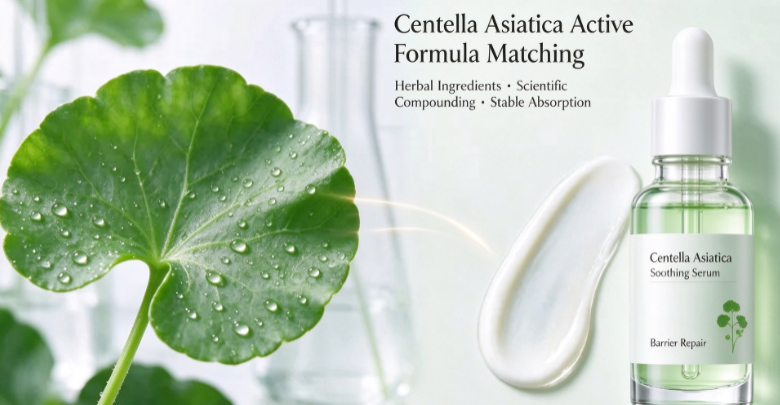
1 Centella Asiatica Extract — The “Infrastructure” of Repair
Centella is probably the most talked‑about plant ingredient in the last five years. Its core actives are madecassoside and asiaticoside, with a very clear target: inhibit inflammatory factors, promote synthesis of barrier‑related proteins, and reduce redness and stinging.
Big brands have long moved beyond “trace decoration.” Lancôme’s Hydra Zen soothing cream clearly lists hydroxy‑madecassoside, paired with moringa seed and rose flower extracts for soothing and moisturizing. Another Lancôme line even combines centella with pro‑vitamin B5, specifically positioned as a “Cica repair cream.” Darphin under the Estée Lauder group also lists centella in its core active blend for its smoothing repair cream.
This means centella is no longer a “concept additive.” When an ingredient can be dosed at over 50%, it is no longer storytelling — it’s the functional foundation of the formula.
2 Glabridin — The Most “Expensive” Silent Player in Whitening
Glabridin is an isoflavone extracted from the roots of Glycyrrhiza glabra, known as “whitening gold.” Its mechanism is direct and efficient: inhibit tyrosinase activity, cut off melanin production from the source, and at the same time bring anti‑inflammatory properties to avoid irritation and rebound pigmentation during whitening.
There’s an interesting phenomenon in how big brands use glabridin: international giants use it, but rarely put it in the C‑position. Lancôme’s whitening essence, La Mer’s brilliant whitening serum, Chanel’s sublimage white essence, and Estée Lauder’s intensive whitening spot corrector all contain glabridin in the ingredient list, but it appears more as an “auxiliary ingredient.”
The one who really pushed glabridin to the main position is a Chinese brand. Guyu (谷雨) is currently one of the domestic brands most deeply invested in glabridin. Its whitening products have achieved glabridin purity above 90%, supported by purification patents and liposome encapsulation technology. Guyu’s brightening serum and other products all feature high‑purity glabridin as the core selling point.
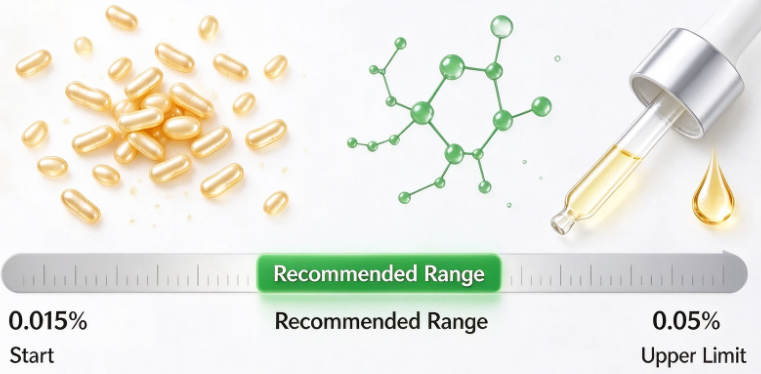
There’s an easily overlooked concentration fact: glabridin works at very low concentrations. Industry group standard discussions mention that for glabridin with 90%+ purity, the recommended whitening dosage is 0.015%–0.05%. Raw material recommendations also fall in the 0.015%–0.1% range. Not high, but purity and formulation environment determine whether it truly works. That’s why there’s a huge gap between “contains glabridin” and “using glabridin as the main whitening force.”
3 Olive Leaf Extract — The “Raw Material Ceiling” for Redness and Inflammation
Olive leaf extract has been pushed to the forefront in the “oily sensitive skin” and “acne‑prone” categories over the past few years. Its core actives are oleuropein and hydroxytyrosol, with a very clear anti‑inflammatory direction: inhibit inflammatory pathways, reduce redness and stinging, and block the “oil‑to‑acne” chain.
This ingredient has an unavoidable “origin story”: SkinCeuticals and Phyto‑C were the first two brands to turn olive leaf extract into star products. SkinCeuticals’ Phyto Corrective serum is built around olive leaf extract combined with rosemary and other botanicals; Phyto‑C directly pushed olive leaf extract concentration to around 10%, known as the “ceiling of olive leaf.” On the raw material side, Hallstar’s Eurol BT series is a landmark ingredient in this track, effective at doses as low as 0.1%, while high‑concentration products can actually contain 3%–10% olive leaf extract.
The formulation challenge with olive leaf extract lies in color and skin feel. High concentrations tend to be dark brown and sticky, and incorporating them into serums requires high‑level formulation engineering. So when you see “olive leaf extract” high up on an ingredient list, it often corresponds to a dedicated technical solution for solubility and stability — not just simple mixing.
4 Portulaca Oleracea Extract — The “Default Option” for Sensitive Skin Formulas
The logic of purslane in skincare is the same as in traditional use: anti‑inflammatory, antibacterial, soothing. Purslane water extract has significant anti‑inflammatory effects, can scavenge oxygen free radicals, and reduce skin irritation reactions.
In the sensitive skin track, purslane is almost a “default option.” Winona (薇诺娜) is a typical example of using purslane as a brand symbol; purslane extract and prickly pear seed oil together form the core botanical framework of Winona’s soothing moisturizing cream, focusing on soothing sensitivity and repairing the barrier. In Yuze’s herbal approach, purslane also frequently appears as the core botanical for soothing.
In terms of concentration, the industry‑recommended addition level for purslane extract is usually 0.5%–5%; for anti‑allergy/soothing purposes it is concentrated at 1%–5%; some high‑concentration sensitive‑skin products can actually contain 3%–6% or even higher.
Purslane’s “dominance” in ingredient lists is not driven by a single hit product but by category penetration: when you open the repair lines of mainstream sensitive‑skin brands on the market, purslane appears so frequently that you almost don’t need to look for it. It doesn’t steal the show, but without it, many soothing formulas would lack their most stable piece of the puzzle.
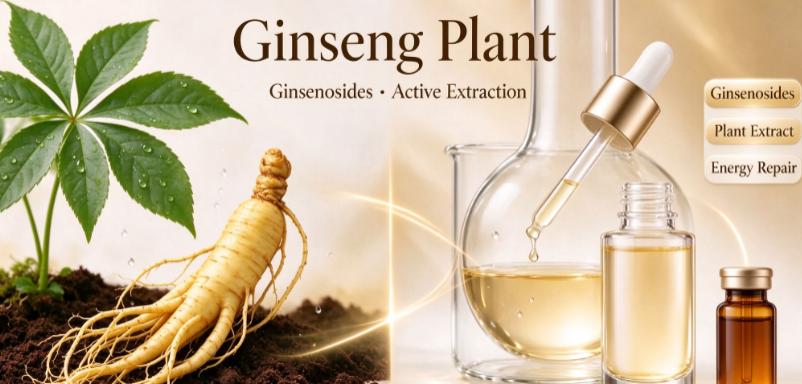
Ginseng Extract — The “Heaviest” Plant Asset in Anti‑Aging
If the previous four are more “efficacy‑type plant extracts,” ginseng is one of the few plant extracts with its own asset thickness. Behind it are decades of accumulated formulation experience, raw material processing, and consumer perception from Korean herbal skincare.
Sulwhasoo is the most typical example of ginseng skincare. Among its 169 unique formulas, ginseng root extract appears in 55% of them, ranking among the top ingredients. Sulwhasoo’s Timetreasure Invigorating serum’s core story is ginsenosides: only 1 gram of ginsenoside is extracted from every 1000 grams of ginseng, then concentrated into Ginsenomics™ microcapsules — a 50ml product contains about 190,000 microcapsules. In some products, ginseng extract can be added at around 3%, and the combined addition of patented red ginseng saponins and white ginseng saponins is estimated at around 10%.
The value of ginseng is not in “plant” itself, but in the fact that it has turned a plant ingredient into an active system with extraction difficulty, concentration thresholds, and patent barriers. When an ingredient starts with a 1000:1 extraction ratio, it has already left the stage of “adding some plant powder.”
Looking at these five together, the pattern becomes clear
Next time you look at an ingredient list, take an extra look at the plant extracts listed near the top. The reason they repeatedly appear in big‑brand formulas is not marketing concepts, but real functional positions.
— End of article · original photo positions preserved —